
Japanese Beetle- Myth or Fact?
Myth vs. Fact: Japanese Beetle Edition
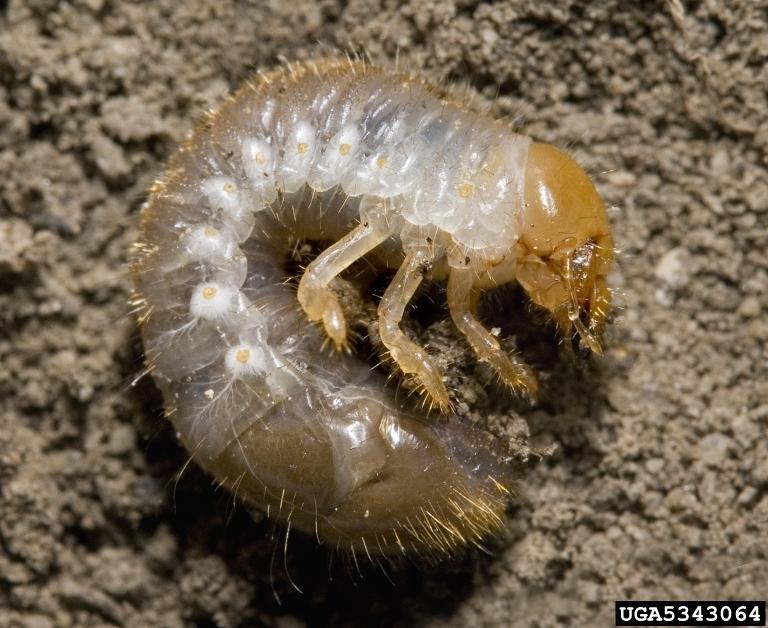
Japanese beetle larva David Cappaert, Michigan State University Bugwood.org, UGA5343064

Adult Japanese Beetle on pink flower, Whitney Cranshaw, Colorado State University, Bugwood.org
Think the Japanese beetle has moved on? Think again. This invasive pest is still threatening our neighborhoods, green spaces, and agricultural industry. Below we separate myth from fact to help you understand how we can eradicate this pest from our community. With strong community support we can work toward eradication together!
Myth: Japanese beetles only damage roses.
Fact: Yes, roses are a favorite of adult Japanese beetles. However, Japanese beetle larvae also feed on grass roots, while adults consume the leaves, buds, and flowers of more than 300 ornamental plant species, including grapes, Virginia creeper, fruit trees such as cherry, plum, and peach. Their broad appetite is what makes their presence in the Grand Valley the most concerning given our extensive agriculture and beautifully landscaped yards, schools, parks, and golf courses.
Myth: I’ve only seen a few beetles, it’s not a big deal.
Fact: According to the University of Missouri Extension Office “Adults produce an aggregation pheromone, resulting in clumped distributions throughout the field.” This means Japanese beetles attract more Japanese beetles and a small number can quickly turn into a large infestation because feeding beetles release scents that draw in more beetles.
Myth: We can just set traps for the Beetles.
Fact: Traps often attract more adult beetles which can increase damage to nearby plants. While they may be useful for monitoring and may aid in control, opinions are split on their effectiveness for eradication.
Myth: Adult beetles are the only problem.
Fact: The larvae (grubs) live underground and feed on grass roots, causing brown patches in lawns. Effective management often requires addressing both life stages.
Myth: There’s nothing you can do without chemicals.
Fact: Drying down lawns from June through September, hand-picking adult beetles, using physical barriers and biological options can all reduce damage without relying solely on broad-spectrum pesticides.
Myth: Japanese Beetle cannot be eradicated
Fact: Japanese Beetles were eradicated in Mesa County between 2002-2008, when aggressive eradication efforts caused a significant decline and eventual eradication of the beetle. Many other States are pursuing eradication and have yielded positive results.
Understanding the facts allows you to make smarter, more sustainable choices for your community, your family, and your pets. For more information about Japanese beetle life cycle, treatments, insecticides, look-a-likes, and their history in Mesa County, check out Western Colorado Insects: Japanese Beetle in Mesa County by Colorado State University Extension.
______________________________________________________________________
The Japanese Beetle Eradication Program was launched after the beetle was detected in north Grand Junction in 2022. Building on a successful eradication in Palisade in the early 2000s, the Mesa County Board of Commissioners designated the beetle for eradication and began offering free treatments to consenting property owners. The eradication efforts protect landscaping, public green spaces, and Mesa County’s agricultural sector, which generates over $58 million in crop income and sustains many hardworking families. Continued success of the program is essential to safeguarding the local economy and the community’s long‑term prosperity.
Contact:
jb@mesacounty.us
970-902-3886