
Build Responsibly
Why it matters
Developing in the floodplain can disrupt the land’s natural ability to carry floodwaters. This can:
- Increase runoff
- Raise flood levels
- Damage ecosystems
- Put people, property, and the environment at risk
Development can also increase floodwater’s velocity, height, and runoff, causing flooding in places that have never been flooded before. This can harm not only humans and their property but also native vegetation and wildlife habitats (access the Natural Floodplain Functions web page for more information).

If you choose to develop in a Mesa County floodplain, it is important to follow the Mesa County Land Development Code, obtain the required permits, and work with floodplain management professionals and engineers to ensure that the development has minimal impact on the people and places in its proximity.
Access Mesa County’s Floodplain Development Permit system by completing the following form.
Forms - Floodplain Development Permit
Land Development Code - 2020 (Amended 04-23-24)
High-risk flood areas have special permit requirements. Before you build, fill, alter, or grade your property, always check with the Floodplain Administrator at 970-244-1811 to find out which permits apply. This includes accessory structures of any size, such as sheds and fences, which could potentially block floodwaters and cause localized flooding. It also includes the construction of diversions, which are channels that divert surface runoff from rainwater. For more information, refer to Mesa County’s Land Development Code (Floodplain Regulations). Additionally, if you are hiring a contractor, make sure they are licensed and will be obtaining the required permits.
Floodplain development guidance
Key terms
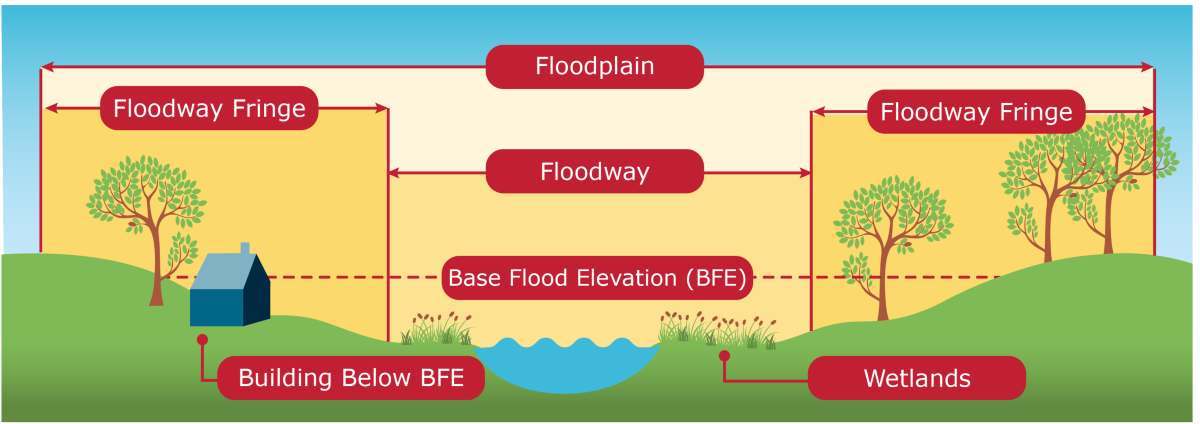
Base Flood Elevation (BFE): The elevation of surface water resulting from a flood that has a 1% chance of equaling or exceeding that level in any given year.
Floodplain: Any land area susceptible to being inundated by floodwaters from any source, often next to a river, pond, lake, or ocean.
Floodway: The channel of a river or other watercourse and the adjacent land that must be reserved to discharge floodwaters without cumulatively increasing the water surface elevation to more than a designated height.
Floodway Fringe: The portion of the floodplain outside of the floodway that usually contains slow-moving or standing water. Sometimes called the flood fringe.
Freeboard: An additional amount of height above the BFE used as a factor of safety in determining the level at which a structure's lowest floor must be elevated or floodproofed to be in accordance with state or local floodplain management regulations.
Developments located in the Federal Emergency Management Agency’s (FEMA) Regulatory Floodplain are subject to specific building and design standards, which can be found in the Mesa County Land Development Code mentioned above. Certain developments are required to furnish Elevation Certificates or Floodproofing Certificates as proof of compliance with NFIP standards (open PDFs in desktop app if web browser is unsuccessful).
To find out if your property is located in a FEMA Regulatory Floodplain, search for your property on Mesa County’s GIS viewer. Make sure to check the Flood (FEMA), FEMA Regulatory Floodplain, and Potential Flood Hazard Area boxes to activate these layers.
Properties with Elevation Certificates
Elevation Certificates are important administrative tools of the NFIP. They can be used to provide elevation information necessary to ensure compliance with local ordinances, inform the proper flood insurance premium, and support FEMA Letters of Map Change. Mesa County collects and stores Elevation Certificates for properties in the floodplain. To request a copy of the Elevation Certificate for any of the properties below, please contact Mesa County Floodplain Administrator Carrie Gudorf at carrie.gudorf@mesacounty.us.
Floodplain development property name and permit number
843 19 Rd, FP04-11
843 19 Rd, FP07-11
352 29 Rd, FP03-08
316 29 Rd, FP07-19
316 29 Rd, FP03-21
332 29 Rd, FP04-23
519 31 Rd, FP01-16
510 34 Rd, FP04-20
530 35Rd,FP05-22
Buzzard Creek Rd, FP06-092875
C1/2 Rd #6, FP01-092784
C1/2 Rd, FP05-142759
C1/2 Rd, FP06-202553
C3/4 Rd, FP07-08635
Carina St, FP07-09
631 Carina St, FP08-09
633 Carina St, FP09-09
637 Carina St, FP11-09
639 Carina St, FP12-09
1982 Cunningham Ct, FP07-10
2536 D Rd, FP03-14
171 Dike Rd, FP03-16
146 Divide Rd, FP07-13
3074 E Rd, FP01-12
3096 E Rd, FP07-14
3103 E 1/2 Rd, FP02-11
3083 F 3/4 Rd, Grand Junction, FP03-13
3087 F 3/4 Rd Grand Junction, FP01-15
3810 G.2 Rd, FP06-10
3812 G.2 Rd, FP01-11
Gateway Canyons Development, FP01-07
3447 Grand Valley Canal Rd, FP02-19
221 Grant Rd, FP03-11
624 Holland St, FP02-18
620 Holland St, FP04-18
619 Holland St, FP08-18
621 Holland St, FP14-18
43200 Highway 141, Gateway, FP01-10
43200 Highway 141, Gateway, FP06-12
43200 Highway 141 -Gateway Canyon Resorts, FP09-14
4078 K3/4 Rd, FP08-08
2085 Kedrowski Ct, FP07-20
2083 Kedrowski Ct, FP01-21
2089 Kedrowski Ct, FP06-22
2087 Kedrowski Ct, FP06-24
2087 Kedrowski Ct, FP03-25
2545 Kenneth Ct, FP03-22
230 Lake Rd, FP02-08
306 Lake Rd, FP13-09
328 Lake Rd, FP03-12
273 Lake Rd, FP11-19
453 McFry Rd, FP03-09
250 Mitchell Rd, FP04-15
274 Montana Rd, FP03-20
3867 N. River Rd, FP02-22
Orchard Grove Sub, FP06-07
293 Power Rd, FP02-09
380 Redd Ln, FP05-09
2089 & 2091 River Rd, FP10-09
847 River Ranch Ct, FP04-17
852 River Ranch Ct, FP03-18
849 River Ranch Ct, FP13-18
845 River Ranch Ct, FP02-21
848 River Ranch Ct, FP08-21
847 River Ranch Ct, FP02-24
851 River Ranch Ct, FP05-24
849 River Ranch Ct, FP01-25
396 1/2 Rosevale Rd, FP02-12
372 Rosevale Rd, FP08-14
407 1/2 Rosevale Rd, FP03-15
383 Rosevale Rd, FP02-16
409 Rosevale Rd, FP05-16
373 Rosevale Rd, FP16-18
398 Rosevale Rd, FP06-19
388 Rosevale Rd, FP01-14
3275 Sagewood Ct, FP05-17
3276 Sagewood Ct, FP07-17
3277 Sagewood Ct, FP01-18
3271 Sagewood Ct, FP05-18
3273 Sagewood Ct, FP09-18
3263 Sagewood Ct, FP10-18
3274 Sagewood Ct, FP11-18
Substantial damages and improvements
Some of Mesa County’s development standards apply specifically to substantially damaged structures and/or substantial improvement projects. If a structure is located within the Special Flood Hazard Area (SFHA) (a high-risk flood area) and needs repair following damage from a storm, fire, flood, or other natural disaster, the cost of the work must be evaluated and compared to the value of the structure before the damage/improvement.
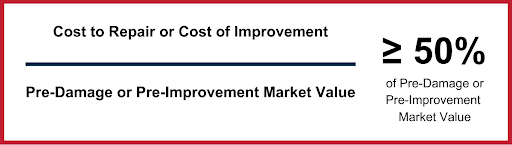
If the cost to repair the structure is 50% or more of the pre-damage market value, then the structure is considered substantially damaged and must be brought into compliance with current floodplain management standards. This requirement helps to prevent future disaster impacts. Current floodplain management standards can be found in the Mesa County Land Development Code.
Land Development Code - 2020 (Amended 04-23-24)
What is substantial damage?
- When the cost to repair a damaged structure in the SFHA is greater than 50% of the structure’s pre-damage market value.
- A structure in the SFHA can receive a substantial damage determination regardless of the cause of damage.
- Substantially damaged structures become substantial improvements when the repair process begins.
What is substantial improvement?
- When the cost of improving, renovating, rehabilitating, or retrofitting a structure within the SFHA is 50% or more of the structure’s pre-improvement market value.
- Determinations of substantial improvement do not account for the value of the property’s land, landscaping, and accessory structures.
- Any repairs made to a substantially damaged structure are considered substantial improvements, regardless of the type of repair performed.
For further guidance on substantial damage and improvement projects, visit FEMA’s Substantial Improvement Substantial Damage website and download the Desk Reference.
For questions concerning floodplain development in Mesa County, please contact Mesa County’s Floodplain Management Program at 970-244-1811 or web-floodplainmanagement@mesacounty.us.
Development in the FEMA Special Flood Hazard Area (SFHA)
FEMA-designated SFHAs are high-risk flood zones that will be inundated by the flood event having a 1% chance of occurrence in any given year. Development inside the SFHA is subject to specific regulations to minimize flood losses. These requirements include elevation or floodproofing of the structure to at least one foot above the BFE (the freeboard). Freeboard is the height above the BFE to which a building’s lowest floor must be elevated. Freeboard acts as a safety buffer against rising water. Adhering to freeboard standards can help lower flood insurance costs.
If you believe your property was incorrectly identified as SFHA, you may submit an application to FEMA for a formal determination of the property’s location and/or elevation relative to the SFHA via a Letter of Map Change (LOMC) request.
Review the application form:
Forms - Conditional and Final Letters of Map Amendment and Letters of Map Revision Based on FILL.pdf
The federal government also requires that development and land use decisions comply with the Endangered Species Act (ESA), which aims to conserve threatened and endangered wildlife and vegetation in the United States. To learn more about the ESA, visit the U.S. Fish and Wildlife Service web page. For more information on floodplain development requirements, visit the Floodplain and Wildlife Conservation FEMA website.
